Translate It!

Friday, June 14, 2013

Happy Father's Day!!! (This Sunday, that is...)

To all my colleagues that this applies to... and anyone else out there:
Happy upcoming Father's Day!
Always strive to be the dad you wish you'd always had!

Sunday, May 26, 2013

Let's See What Happens, Shall We?

     So, we now have my original "Parts of Speech" music video:

     However, you will now also see (at the end of the video) that I have added 3 new versions! First of all, we have the "eduoke" version (education + karaoke... I'm always trying to coin new terms or revive old ones, ok?!). In the eduoke version, you can see the lyrics as you watch the video. It should help any student to understand everything I sing as well as study the grammatical rules embedded in the song:

     I also now have a version that I like to call "cloze captioned" (I think this term will catch on!). In this version of the song, you still have the karaoke facet, but key terms have been deleted from the lyrics. This practice, known as a "cloze" activity, will allow students to think critically about what term is missing and why it makes sense in that space. They will also be challenged to slowly, but surely, memorize the song, and subsequently, the grammatical rules concerning the way we use nouns, verbs, and adjectives in the English language in the case of this song:

     Finally, I have the "lyric free and vocally yours" version (this new term doesn't quite flow off of the tongue as easily... but I like it... so, there). It's pretty self-explanatory if you ask me. In this version, you can hear the instrumental version of the music. My vocals have been removed and the lyrics (those of which were an overlay on the original video) have also been omitted. This, in a way, is the big test (but a fun one)! What have students remembered? What are they still unsure of? Can they "show what they know?" This is the video that will help us find out:

     The plan is to make these versions of each music video I do. The music video for "Dangling Participles" is now in the making and the lyrics for "Sentence," describing the possible uses of the four main sentence types, are complete (recording still needs to happen though). I'm excited to see where this goes. I hope you are, too.

Thanks to everyone for your support and encouragement!
Just click SUBSCRIBE to be regularly updated as I add more videos.

Tuesday, April 30, 2013

WIDA Data Digging is Daunting!

Last week, I received a two-day crash course introduction to deriving integral instructional information from WIDA data that we receive annually after administering the ACCESS test.

During cup after cup of coffee, I learned so much about what the scores represent (raw scores versus scale scores), which to use when exploring students' personal strengths and weaknesses across domains, how to analyze a students growth throughout their ELL career, and oh so much more.

After having received this professional development, I have inundated myself with the data surrounding my school's students. This is tedious and somewhat monotonous work, but I see the value in it. I do wish, however, that I had more time to pick the brains of these WIDA representatives. As people who work closely with those who created this assessment, they were able to convey a great deal of insight as to why we receive the score reports we do and which scores are important to pay attention to depending on what one is looking for.

Upon returning to work, I can see that I have a lot of digging to do through at least 4 years of data for my school's individual ELL student population. Going through WIDA data dating back to the 2008-2009 school year for student after student and then making graphic depictions of that student's true progress is painstaking, but such a valuable experience! All I can say is that I wish I had known all of this stuff earlier! The more I'm learning, the more it's feeling like common sense, but it still (for some reason) needed to be spelled out in order for me to begin this endeavor.

I enjoy what I'm learning, but it is still proving to be a difficult process. There's much more left to be understood for the sake of our students. I feel up to the task, but I also feel pulled in so many other directions.

Here's to hoping for some insight as to when to go in which direction!

Saturday, April 20, 2013

Cloze Captioning is the Key!

My "Parts of Speech" song has had over 20 thousand hits since I posted it last year. I've received plenty of positive comments encouraging me to create more. I really want to, but there are two things I need to make sure I figure out how to do before I move on to "bigger and better things:"

- First of all, I need to discover how to manage the copyright issues. Timbaland's "Give It to Me" is the original song through which I deliver "Parts of Speech" and I'd like to eliminate the copyright infringement that I am technically committing right now. When I first posted the video and saw that it had limited viewing capabilities because of the copyright problem, I began trying to figure out how to go about resolving the conflict, but that eventually fell to the wayside as life inevitably took over. I'd like to rectify that as soon as possible though.

- Secondly, I'd like to figure out how to make a profit from what I do. It was a great deal of hard work to create that song. Putting time into changing the lyrics as well as creating the video was no simple feat and I'm quite proud of the results given my resources. I'd like to continue to make more of these types of videos because I see the value in their production. I see how useful they can be to others. So the question becomes, "How can I allow myself to keep creating these educational song videos and, perhaps, make it worth my while monetarily?"

I am finally starting to see an answer to my second concern slowly emerge. Some of the comments left on my page were requests asking for the song's lyrics to be posted, perhaps even set up as a caption to the video. I began to do that, but it wasn't working very well. I then thought I would be able to set it up to work karaoke style and I also took it a step further.

I'm thinking of making at least two more versions of the same video with lyrics support. One version will have the complete set of lyrics pop up on the screen as the song plays while yet another will have what I like to refer to as "cloze captions."

In a cloze activity, learners are to fill in the blanks of already established portions of a given text. The kids aren't just making up words, the omitted words are key words that encourage critical thinking and help assess a student's knowledge of the subject matter.

I think that it is through the production of these two videos that I will be able to make a profit (once the copyright issues are resolved). After posting the original video, I need to make available the sale of the karaoke and cloze captioned versions of the videos and I see a great deal of value in the learning process.

I've got to make this happen!

Sunday, March 24, 2013

Am I a closet dialect dogmatist?!

Thanks to this year's Spring issue of Teaching Tolerance, a potential revelation was made to me: I very well may be <<deep sigh>> a bigot... vernacularly speaking, of course. I feel as though I speak a fairly safe version of Standard American English, "non-accent" sentiments included. In other words, all those who do not sound like me have an accent while I do not... from my perspective.

Upon reading this article, my thoughts as to what is deemed "correct English" were thoroughly challenged time and time again. To begin with, it exposed my mild antipathy for incorrectly spoken (or written) English. The author here, proposes that (and this is backed up empirically) specific accents have been vilified via indoctrination into our culture as negative.

In almost any Disney film, for example, Southern accents or "Black American English" are normally used by the villains while the protagonist has a standard British or American dialect. Studies revealed young children to determine how nice someone might be based on their accent, for crying out loud!

After the shock of the content of this article began to wear off, I realized that it was so true! I get paid, however, to teach those students to whom English is not their first language the acceptable conventions of this language... and it irks me to no end when I hear the acquisition of incorrect English through peer conversations. Abhorrent phrases like, "That's mines," or perhaps, "He be trippin', yo!" or the up-and-coming, "I'ma look at that jawn tomorrow..." pierce my ears and I swear, I'm developing a twitch of sorts because of it.

This article proposes that I validate such speech. However, I cannot. Our world is full of stereotypes. It's actually quite naturally so. We, as human beings, are in constant search of patterns. It's how we learn. We gather experiences, compare them to one another, and seek out patterns from the conglomeration. The patterns we find over time develop our inevitable set of stereotypes. The less stereotypes of people we develop based on appearance and speech, the better, but if a pattern tends to emerge, most people will acknowledge it until they find a circle peg that's just not fitting the square hole.

Don't get me wrong! I'm all about challenging stereotypes. I'm an Oreo Cookie incarnate according to some of my peers (because I'm black, but I don't sound or dress like I'm "black," a.k.a. "from the inner-city..." which I'm supposed to be... because I'm black and that's where we're all supposed to be from, apparently). People's stereotypes are challenged all the time when they meet me.

This having been said, I feel as though I would be doing a disservice to any student who comes into contact me using a broken, "urban" version of the English language without being fully functional in standard English and does not receive correction from me. Our culture does not accept it in all arenas.

A person who speaks a version of the "indoctrinated" incorrect English will more often than not have a more difficult time getting an interview for a given job, said candidate's competency in the skill set for that job aside. Unfair as it may be, it is certainly how our immediate cultural environment currently functions.

So, if you want to be an agent of change in this arena, you'd better learn the correct standard version of English first. Otherwise, you will find that a very low percentage of the hiring population will even give you the time of day to demonstrate your competency, however strong it may be. The way you dress is your first test. The way you speak, in my opinion, is the second.

Sincerely,
Broken-English Bigot

Wednesday, March 6, 2013

Response to "You Can Close the Door (Sometimes)"

I couldn't agree more with the author of this article.

Reflection used to be a much more natural and very integral part of my everyday life and there is a great deal of personal growth that emerges from this kind of intentionally meaningful contemplation.

Why, then, is it so hard for me to actually embed this into my work life? It's an annual requirement for crying out loud. I think to myself, "Well, this is a piece of cake because I enjoy thinking about what I do and how I can improve it," but I inevitably fall behind in actually doing the work-related reflection in a timely manner.

I don't know what holds me back. I could easily use the "I just don't have time for this..." excuse, but that's simply not true. I can make time for it. I could record myself talking in the morning and transcribe it in the evening or something.

It's my procrastinating nature, for sure. I can't stand this part of me and I'm working hard to overcome this weakness, but it is a real doozy, this one. I need help, but I don't know what help I need. I have a schedule and I manage to stay fairly organized, but I must say, if procrastination is my first weakness, organization is a close second.

I love my job and I do it well, I believe. Well, the part that hooked me in the first place, anyway. I connect to my kids, and I'm very knowledgeable in my craft. They learn from me... and that's the point ultimately, isn't it? At the same time, I miss deadlines (sometimes very important ones), I can seem asocial at times because I just refuse to sit and gossip about who said what with the rest of the grade teams and so I can seem MIA, when in fact, you can always find me working.

I'm also a very creative soul, but that means I come up with idea after idea and it leaves me with no time to actually explore the expansion of any one of those ideas to their fullest potential because of the mandates that I am already falling behind on! <<gasp>>

Breathe, Folkes... just breathe.

I frustrate myself to no end with my two weaknesses, but what do I do? I'm going to try to keep up with my responsibilities by being two steps ahead. Deadlines should be posted on my computer screens (I travel from one side of the school to the other throughout the day). I need to become my own secretary.

How do some people do it though? I'm not alone, you know? I'm just talking about my work life here, but I'm also a husband, father, son, friend, etc... all wrapped into one.

I need to close the door sometimes. It would help me be better organized and procrastinate less, but if I do that, the door will always be closing on somebody or some opportunity... and I always have a hard time doing that for the sake of my own sanity.

That's a blessing and a curse wrapped into one as well. So what I do? Just keep going... but I know there's got to be a better way than this...

Monday, February 11, 2013

Social Media and Technology... They're here to stay.

This picture just about says it all.

We are in a very revolutionary period of education right now. Social media have the potential to completely turn the system on its head if we don't adapt.

Children have access to the internet in so many different venues, yet they just don't know what to do with it. For the most part, they have somewhat limited communications skills, yet they have numerous forums through which they can share ideas, collaborate, evaluate, inform, etc. This list just goes on and on!

Take this "Twitter Spectrum." What a productively meaningful way to merge relevant methods of literary analysis with current technology! This is a wonderful example of how our children are growing up. It is evident here that we can help them to use the technology at their fingertips to its utmost potential.

We still really have to work on the conventions of language however. Plenty of tweets run a muck through the English language. Twitter is also a prime example of how any language can get butchered via the abbreviating of word after word in order to say as much as one possibly can in 140 characters or less.

Now, I actually see lots of potential for wonderful vocabulary exercises that allow students to manipulate words (provided that they know how the words should be spelled in the first place), but I also see the potential for total obliteration of language, perhaps even linguistic Armageddon, if we educators do not keep our hands in the technology arena.

Social media and other technologies are not going anywhere. That's for sure. They will only permeate our lives more and more until they become an integral part of life. In fact, this stage is approaching quickly. It's imminent. The generation that can do without such things is depleting in most of the world, that is). They're our grandparents... our mentors... our wise benefactors... but they are leaving. We need to make sure the up-and-comers keep the best of both worlds and it has to be us because we're the "in-between."


Monday, January 7, 2013

Making PD Stick...

So, EducationWorld recently threw out a few "best practices" for promoting the importance of making what is learned during professional development a bit more permanent and accessible post-learning.

I personally like the theme of this article a great deal because it implies that PD is important... important enough that it ought to remain current and at the forefront of our minds for a duration that lasts longer than the day on which it is received and practiced.

I think that we, as a teaching staff on the whole, all too often neglect to give most PD received a fighting chance at classroom implementation. That is not to say that we don't try it out, but I do think that, more often than not, it dies away fairly quickly. Why is that though?

Well, first of all, most teachers have already developed a routine of some sort. Either that, or one has been developed for them and it can be hard for those teachers to "change it up," so to speak. Perhaps the PD covered modifying lesson plans to better address the current capabilities of English Language Learners (ELLs) in an all-inclusive classroom, or maybe Response to Intervention (RTI) implementation methods was discussed... Most teachers, I believe, do wish to continually develop their craft, but they (at least I know I) have a hard time putting their newly discovered knowledge into regular practice until it becomes part of the aforementioned routine.

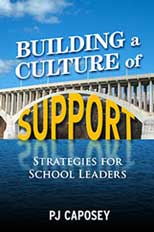
PJ Caposey may be onto something in his book, "Building a Culture of Support: Strategies for School Leaders." Out of the six strategies mentioned as ways to promote professional development of staff members, I believe I liked the third most: voluntary book blogs.

I like the idea of being able to (as a collective group) dive into a particular subject matter and discuss what is being read with one another at random times in an online forum. It allows the staff members to actually take in what is being learned and further discuss (and perhaps implement) key topics.

It also provides an on-going record of what worked (and what crashed an burned) with a particular new practice or school-wide mandate. This particular activity promotes meaningful discussion without a time constraint and meaningful discussion can only happen after critical thinking has occurred. Once critical thinking has happened, there is ownership involved in the learning, and I believe whatever is taken in through such a complicated lens is not as easily forgotten. It's just a thought...